What Security Teams Should Take From This
Most physical security guard companies don’t actually have a lead generation problem — they have a lead quality problem. Referrals trickle in, the phone rings occasionally from an old directory listing, and every few months a competitor’s bid beats theirs on a contract they should have won easily. The issue usually isn’t a lack of activity. It’s a lack of a deliberate system for generating leads for physical security guard companies that are actually ready to buy.
That distinction matters because the fix is different depending on which problem you actually have. If you have no leads at all, you need visibility. If you have leads that never close, you need better qualification. Most guard companies need both, built into a single, repeatable system rather than a scattered mix of tactics.
The principles below apply across the industry; if you want the same system built for a broader security operation, see our lead generation for security companies service.
Why Lead Generation Looks Different for Security Guard Companies
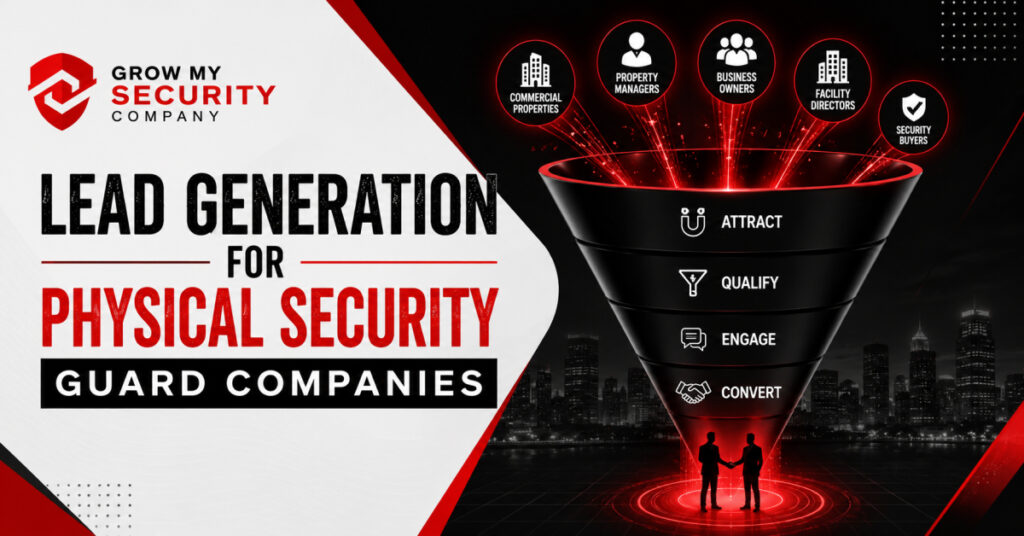
Security buyers — property managers, facility directors, HOA boards, event organizers, retail operators — don’t shop the way consumers shop. A few things shape how lead generation for physical security guard companies actually has to work:
The decision involves real liability. Hiring a guard company means trusting someone with the physical safety of a property, its occupants, and sometimes significant assets. That means buyers move more cautiously than they would for a typical local service purchase, and they’re looking for proof — licensing, insurance, bonding, past performance — before they’ll even take a call seriously.
Contracts are often recurring, not one-time. Unlike a lot of local service businesses, a single won contract with a commercial property or facility can represent months or years of recurring revenue. That changes the math on what a lead is actually worth, and it justifies a more deliberate, higher-touch lead generation approach than chasing volume alone.
Buyers compare more than price. Especially for larger commercial contracts, the decision usually comes down to a mix of price, coverage reliability, licensing, and communication — not just who quoted the lowest hourly rate. Lead generation that leads only with price attracts exactly the wrong kind of prospect: the one who will leave the moment a cheaper option appears.
Building a Real Lead Generation System
1. Start With Local Search Intent
A large share of qualified guard company leads come from people actively searching for a provider right now — “security guard company near me,” “commercial patrol services [city],” “event security company [city].” Capturing this demand requires two things working together: strong local SEO (so you show up organically) and, often, paid search (so you show up immediately while SEO builds).
The mistake many companies make is treating these as separate, disconnected efforts. A coordinated system where paid search and SEO reinforce the same landing pages and messaging consistently outperforms either channel run in isolation.
Our lead generation service for security companies is built around that coordination rather than running the two channels separately.
2. Build Conversion-Focused Landing Pages
Traffic without conversion isn’t a lead generation system — it’s just traffic. Every campaign, whether paid or organic, should point to a landing page built specifically to answer the questions a security buyer has before they’ll reach out: What’s your response time? What’s your coverage area? Are you licensed and insured in this state? What does the process look like from inquiry to signed contract?
Pages that skip this information and rely on a generic “Contact Us” form consistently underperform pages that lead with proof and clarity.
3. Qualify Before You Chase
Not every inquiry deserves the same follow-up speed or sales effort. A system that scores or segments leads — by contract size, urgency, and service type — lets your team prioritize the opportunities most likely to close, instead of spending equal time on every form submission regardless of fit.
This is where a lot of guard companies leave value on the table. A lead from a facility manager evaluating a full campus contract and a lead from someone asking about a single weekend event both land in the same inbox, get the same generic follow-up, and often get treated with the same (or worse, inverted) priority.
4. Follow Up Fast, and Follow Up With Proof
Security buyers researching multiple providers at once will often go with whoever responds first with a credible answer — not necessarily the lowest bid. A follow-up process that responds within minutes or hours, not days, and leads with proof (licensing, insurance, relevant case studies) closes noticeably more of the leads that are already coming in.
5. Track What’s Actually Converting
Lead volume is a vanity metric if it’s not tied to what’s actually closing into signed contracts. A basic system for tracking lead source, follow-up speed, and close rate reveals which channels and campaigns are worth scaling and which ones are quietly wasting budget, even if they’re producing plenty of raw inquiries.
Common Lead Generation Mistakes in This Industry
Relying entirely on referrals. Referrals are valuable, but they’re unpredictable and don’t scale with the business. A deliberate lead generation system fills the gaps referrals leave and gives you control over growth instead of waiting on word of mouth.
Generic, one-size-fits-all campaigns. A campaign built for retail loss prevention leads won’t speak to an executive protection buyer, and vice versa. Segmenting campaigns and landing pages by service type and buyer type consistently outperforms a single generic funnel trying to serve everyone.
No system for slow-moving enterprise leads. Some contracts take months to close. Without a nurture process — follow-up content, check-ins, proof points delivered over time — those slower-moving, often higher-value leads quietly go cold and end up going to whichever competitor happened to stay in touch.
Ignoring mobile experience. A meaningful share of security buyers, especially those searching urgently, are on a phone when they find you. A landing page that’s slow, hard to navigate, or has a form that’s painful to fill out on mobile loses leads before they ever get a chance to convert, no matter how good the campaign targeting was.
Treating every lead the same regardless of source. A lead from organic search, a paid ad, and a referral often arrive with very different levels of intent and context. Routing all three through the exact same generic follow-up script misses the opportunity to tailor the conversation to how warm or informed that particular prospect already is.
Frequently Asked Questions
What’s a realistic cost per lead for a security guard company? This varies significantly by market and service type, but commercial security leads typically cost more than general local-service leads due to higher competition and contract value. What matters more than the raw cost is the close rate — a slightly more expensive lead that converts at twice the rate is a better investment than a cheap one that rarely closes.
Should we focus on SEO or paid ads first? If you need leads quickly, start with paid search while SEO builds in the background — SEO typically takes 60–90 days to show meaningful movement. The strongest long-term systems run both channels together, pointing to the same well-built landing pages.
How do we generate leads for larger commercial contracts specifically? Larger contracts usually require a more deliberate, longer nurture process rather than a single landing page and form. That means dedicated content addressing enterprise-level concerns, a follow-up cadence built for a longer sales cycle, and case studies specific to similar-sized engagements.
Getting Started
If you’re building or rebuilding your lead generation system, the highest-leverage starting points are: get local search and paid search working together instead of separately, build landing pages that lead with proof instead of generic descriptions, and put a basic lead-scoring or segmentation process in place so your team’s time goes toward the opportunities most likely to close.
Work With a Security-Focused Lead Generation Team
We build lead generation systems specifically for physical security guard companies, built around commercial trust and decision-stage intent rather than generic form-fills. One client saw 3X lead volume within two quarters of this exact approach, without increasing their overall ad spend.
If your current lead flow feels unpredictable or your close rate feels lower than it should be, book a free growth consultation and we’ll show you exactly where the system is breaking down.