What Security Teams Should Take From This
Most electronic security integrators generate leads the same way they always have — referrals, existing client relationships, and the occasional inbound call from someone who found them through a general contractor. That pipeline works, but it’s inconsistent, hard to scale, and leaves a significant amount of demand on the table: the buyers who are actively researching integration options online right now and have no existing relationship with your company at all.
Lead generation for electronic security integrator companies has to solve a different problem than lead generation for most other security niches. The buyer pool is smaller and more technical, the sales cycle is longer, and a single won project can represent months of recurring value. That changes what a “good lead” actually looks like and how you should go about generating one.
Why Generic Lead Generation Doesn’t Work for Integrators
The buying committee is bigger than one person. A facilities director, an IT manager, and sometimes a procurement lead are all evaluating the same project from different angles. A lead generation system built around a single decision-maker persona misses two-thirds of the people actually involved in the decision.
The sales cycle is measured in months, not days. Unlike a same-day emergency guard request, an integration project might take three to six months to move from first contact to signed contract. A lead generation system that only tracks form fills and immediate follow-up misses the much larger group of prospects still in an extended evaluation window.
Buyers expect technical credibility before they’ll engage. A generic “request a quote” form with no supporting technical content signals that a company may not have the depth to handle a complex project. Integrators who lead with real technical substance — platform compatibility, integration case studies, specific project scope — earn engagement that a bare contact form never will.
Building a Lead Generation System That Actually Fits
1. Capture Demand at the Research Stage, Not Just the Ready-to-Buy Stage
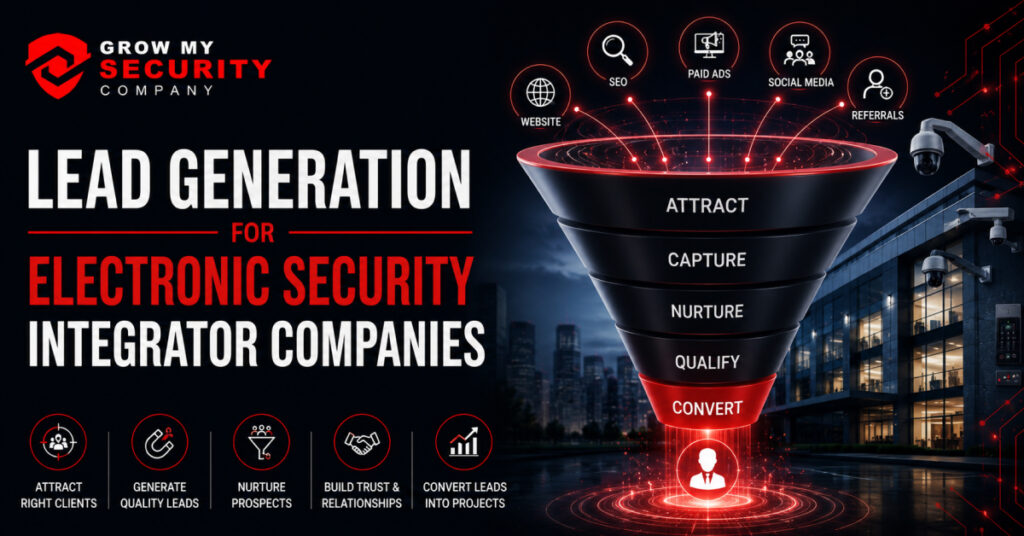
Because the integrator sales cycle is so much longer, a lead generation system focused only on bottom-of-funnel “request a quote” traffic misses the majority of the buying journey. Gated technical resources, detailed case studies, and educational content addressing common integration questions capture prospects earlier — while they’re still researching and comparing options — and keep your company visible throughout the months-long evaluation that follows.
2. Build Landing Pages Around Specific Solutions, Not Generic Services
A prospect researching access control integration and a prospect researching video surveillance integration have different questions and different technical concerns. Dedicated landing pages built around specific solution types — rather than a single generic “lead generation” or “contact us” page — convert better because they speak directly to what the buyer is actually evaluating.
3. Nurture Prospects Across a Multi-Month Timeline
A single follow-up email after a form submission isn’t enough for a sales cycle that can stretch across two or three quarters. An email nurture sequence that continues delivering relevant technical content, case studies, and proof points over time keeps your company top of mind through the full evaluation window — instead of losing the prospect to whichever competitor happened to stay visible longer.
4. Target the Right Job Titles, Not Just the Right Company Size
Facilities directors, IT managers, and security directors all evaluate integration projects, but they respond to different messaging and different channels. LinkedIn advertising in particular allows targeting by specific job title, which is far more precise than broad demographic or company-size targeting alone — especially valuable when the buyer pool for large commercial projects is genuinely small.
5. Give Referral Partners Something to Actually Share
General contractors, architects, and property managers frequently refer integration work, but most integrators have no deliberate strategy for equipping those partners. A simple capability overview or portfolio piece that a referral partner can confidently pass along makes it easier for those relationships to keep producing leads consistently, rather than sporadically.
Common Lead Generation Mistakes Integrators Make
Relying entirely on the existing referral network. Referrals are valuable but don’t scale predictably, and they leave a business vulnerable if a single key relationship changes or dries up.
Treating every inquiry the same regardless of project size. A small single-building request and a multi-site enterprise rollout require completely different qualification and follow-up approaches. Routing both through an identical process wastes time on the wrong opportunities.
No system for nurturing slow-moving prospects. Given how long integrator sales cycles run, a lead that doesn’t convert in the first few weeks isn’t a lost lead — it’s a prospect still evaluating. Without ongoing nurture, those prospects quietly go cold and eventually choose a competitor who stayed in touch.
Underinvesting in technical proof. Case studies with real platform names, project scope, and measurable outcomes build far more credibility than generic service descriptions, yet many integrator websites still lean on vague claims instead of specifics.
Ignoring mobile and slow-loading landing pages. A meaningful share of research-stage traffic, especially from facilities managers browsing between meetings, happens on a phone. A slow or clunky mobile experience quietly loses prospects before they ever engage with the content that was supposed to earn their trust.
How to Prioritize If You’re Starting From Scratch
For an integrator with little existing lead generation infrastructure, the highest-leverage starting points tend to be: build two or three solution-specific landing pages instead of relying on one generic contact form, publish a handful of detailed case studies with real technical specifics, set up a basic nurture sequence for prospects who aren’t ready to convert immediately, and equip your top referral partners with something simple they can actually share. These steps don’t require a large budget, but they do require consistency — a lead generation system in this industry compounds over months, not days.
Frequently Asked Questions
How is lead generation different for integrators compared to guard or monitoring companies? Integrator lead generation has to account for a longer, more technical, multi-stakeholder sales cycle, which means more emphasis on research-stage content and nurture, and less reliance on immediate-conversion tactics that work well for faster-moving security niches.
What’s a realistic cost per lead for an integrator business? This varies significantly based on project size and region, but integrator leads for larger commercial work typically cost more than general local-service leads due to smaller audience size and higher competition for qualified technical buyers. Close rate and project value matter more than raw cost per lead.
Should integrators use LinkedIn or Google Ads for lead generation? Both have a role. Google Ads captures active, high-intent searches from buyers already looking for a solution, while LinkedIn allows more precise targeting by job title for reaching specific stakeholders in a longer, more considered buying process.
How long before a lead generation system produces signed contracts? Given typical integrator sales cycles, it often takes longer to see contracts directly attributable to a new lead generation system compared to faster-cycle security niches — but lead volume, engagement, and qualified pipeline typically show improvement within the first few months.
Work With a Security-Focused Lead Generation Team
We build lead generation systems specifically for electronic security integrators, built around the longer sales cycles and technical buyers this category requires. If your current pipeline feels unpredictable or too dependent on referrals alone, book a free growth consultation and we’ll show you exactly where the opportunity is.