What Security Teams Should Take From This
Electronic security integrators sit in an unusual spot in the marketing world. The work is deeply technical — access control, video surveillance, alarm systems, IP networking, sometimes full building automation — but the buyers evaluating that work are often comparing vendors the way they’d compare any other major capital purchase: on specifications, integration capability, past performance, and long-term reliability. Most marketing agencies default to one of two failure modes with integrators: either the marketing is too generic (treating the integrator like any other local security company) or too technical (reading like an engineering spec sheet with no clear path to a conversation).
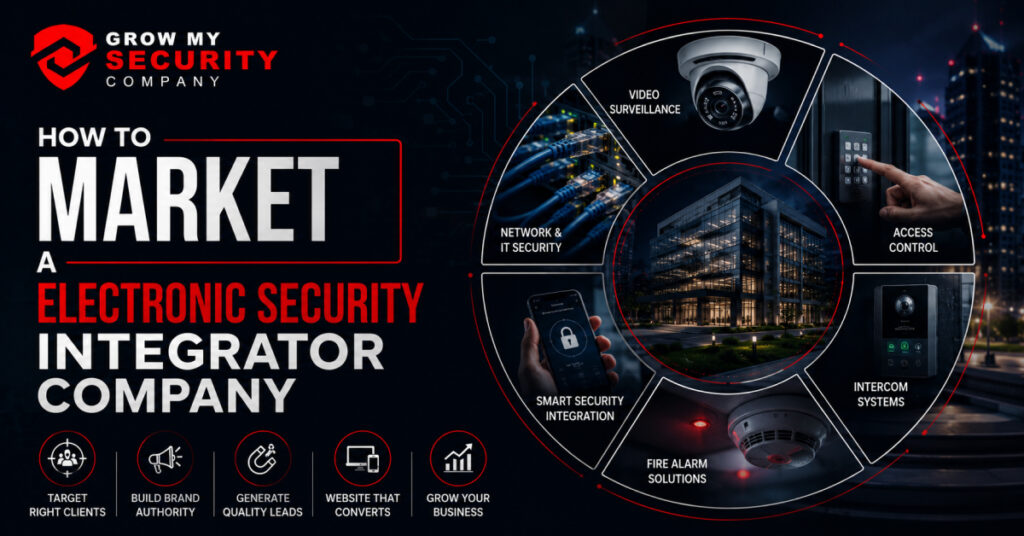
Knowing how to market an electronic security integrator company means finding the middle ground — content and positioning technical enough to earn credibility with a sophisticated buyer, but structured enough that it actually moves that buyer toward a proposal request.
Understand Who’s Actually Buying
Before any tactic gets chosen, it’s worth being specific about who evaluates an integrator. This isn’t usually a single decision-maker. It’s often a mix of a facilities director or property manager (concerned with reliability, uptime, and vendor responsiveness), an IT stakeholder (concerned with network integration, cybersecurity, and compatibility with existing systems), and sometimes a procurement or finance role (concerned with total cost of ownership and contract terms).
Marketing that speaks to only one of these audiences underperforms. A site full of technical specification sheets ignores the facilities buyer who just wants reassurance the system will work reliably. A site full of vague “trusted partner” language ignores the IT stakeholder who needs to confirm actual platform compatibility before recommending a vendor internally.
Build a Website That Proves Technical Capability
Your website is frequently the first serious evaluation point in a longer sales cycle. For integrators specifically, that means the site needs to do more than look professional — it needs to demonstrate real technical depth.
Lead with integration capability, not just product categories. A buyer researching integrators wants to know what platforms and systems you work with, what you can connect to existing infrastructure, and what your actual installation and support process looks like — not just a list of “access control” and “video surveillance” as generic service categories.
Include real project examples with enough detail to matter. A one-line case study (“Installed cameras for a retail client”) tells a technical buyer nothing. A case study that mentions the platform, the scale, the specific challenge solved, and the measurable outcome gives that same buyer something they can actually evaluate against their own project.
Make compliance and certification information easy to find. Depending on your specialty, that might mean licensing, manufacturer certifications, or industry-specific compliance standards. Burying this information (or leaving it out entirely) costs credibility with a buyer who’s specifically looking for it.
SEO Built Around Technical and Commercial Search Behavior
Integrators benefit from SEO more than most security niches because buyers frequently research extensively before ever reaching out — comparing platforms, reading about integration approaches, and researching vendors by name and by capability. That means SEO for electronic security integrator companies has to account for two different kinds of search intent: broad research-stage questions (“how does access control integration work”) and narrow, high-intent commercial searches (“access control integrator for multi-building campus”).
Both deserve content. Broad questions build topical authority and often rank more easily, while narrow commercial searches convert at a much higher rate. A strong integrator SEO strategy builds both layers rather than focusing only on one.
Lead Generation That Respects a Longer Sales Cycle
Unlike some security niches where a lead might close within days, integrator sales cycles — especially for larger commercial or enterprise projects — can stretch across months. That has real implications for lead generation.
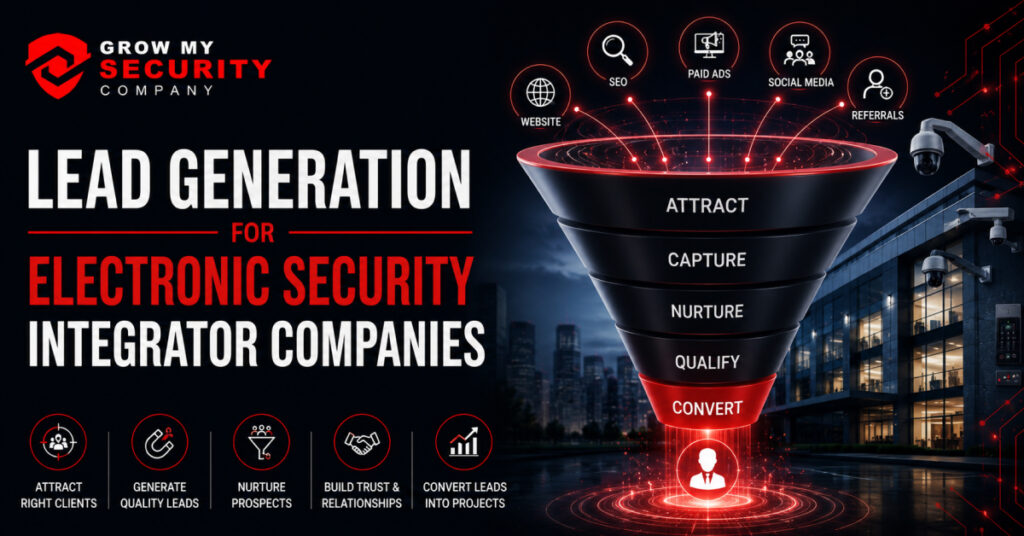
A lead capture strategy built only around “request a quote” forms misses the much larger group of prospects who are still in the research phase and not ready to talk to sales yet. Gated technical resources, detailed case studies, and email nurture sequences that continue delivering value over weeks or months keep your company visible throughout that longer evaluation window instead of losing the prospect to whichever competitor happened to stay in touch.
Advertising That Targets the Right Technical Buyer
Paid advertising for integrators works best when it’s narrowly targeted rather than broad. Google Search campaigns built around specific, high-intent technical and commercial terms tend to outperform broad brand-awareness campaigns, since the buyer pool for enterprise-level integration work is genuinely small and specific.
LinkedIn advertising deserves particular attention here, since it allows targeting by job title (facilities director, IT manager, security director) and company size in a way that’s difficult to replicate on other platforms — especially valuable when your ideal buyer is a specific type of enterprise or institutional decision-maker.
Common Marketing Mistakes Integrators Make
Treating the website like a product catalog. Listing every product line and manufacturer partnership without context doesn’t help a buyer understand which solution fits their specific situation.
Ignoring the non-technical stakeholder. Even in a technical sale, the person who ultimately signs off is often weighing budget, vendor reliability, and business risk as much as technical specifications. Marketing that speaks only to the engineer in the room misses the rest of the buying committee.
No clear differentiation from competitors. Many integrator websites read almost identically to each other — similar language, similar generic claims of expertise. Specific proof, named platforms, and detailed project outcomes are what actually separate one integrator from another in a buyer’s mind.
Underestimating the length of the sales cycle. A marketing plan built around fast conversions will consistently disappoint in this category. The strongest integrator marketing accounts for a multi-month, multi-touch buying process from the start.
Positioning: What Makes an Integrator Worth Choosing
Beyond individual tactics, the businesses that market themselves most effectively in this space tend to have a clear, specific answer to a simple question: why this integrator over the dozen others in the region offering similar services? Vague answers — “quality service,” “experienced team,” “customer-focused” — don’t differentiate because every competitor claims the same things.
Stronger positioning usually comes from being specific about what you’re actually best at. That might be depth with a particular platform ecosystem, experience with a specific building type (healthcare, education, multifamily, industrial), a track record with complex multi-site rollouts, or a specific service model (24/7 monitoring support, guaranteed response times, in-house technicians versus subcontracted labor). Whatever it is, that specific strength should show up consistently across the website, case studies, and sales conversations — not buried in a single sentence on an About page.
Building Referral and Partner Channels
Much of the integrator business comes through relationships — general contractors, architects, property management companies, and existing clients referring new work. Marketing efforts often focus entirely on direct-to-buyer channels and overlook this referral layer, which can be just as valuable to nurture deliberately.
That might mean creating specific content or resources referral partners can actually share (a one-page capability overview, a portfolio of relevant project types), staying visible to past clients through occasional updates or case studies, and making sure your website gives a referral partner enough confidence to make an introduction without hesitation. A general contractor who refers you to a client is putting their own reputation on the line — the easier you make it for them to feel confident doing that, the more referrals tend to follow.
Reporting on What Actually Matters
Given the longer sales cycles in this industry, it’s easy for marketing reporting to default to top-of-funnel metrics — website traffic, impressions, form fills — that don’t tell you much about whether marketing is actually contributing to closed business. A more useful reporting approach ties marketing activity to pipeline stage: how many qualified conversations came from organic search versus referrals versus paid campaigns, how long prospects typically take to move from first contact to signed contract, and which content or channels are actually associated with deals that eventually close.
This kind of reporting takes more effort to set up than a simple traffic dashboard, but it’s the only way to know with any confidence whether marketing spend and effort are actually paying off in an industry where the feedback loop between marketing activity and revenue can take months to show up.
Pricing and Proposal Presentation
For a technical, considered purchase like an integration project, how a proposal is presented can matter almost as much as the pricing itself. A proposal that reads like a generic quote — line items with no context — leaves a buyer to guess at value on their own. A proposal that clearly explains the reasoning behind system design choices, references similar past projects, and lays out implementation timelines in plain language gives a buyer far more confidence to move forward, especially when they’re presenting your quote internally to other stakeholders who won’t be on the sales call.
This matters for marketing too, not just sales, because the same clarity that makes a strong proposal also makes strong website content. If your team already has language that explains system design decisions clearly to a non-technical buyer in a proposal, that same language often translates directly into stronger web copy, case studies, and sales enablement material.
Frequently Asked Questions
How is marketing for integrators different from marketing for guard companies? Integrator sales cycles are typically longer and involve more technical evaluation, often with multiple stakeholders weighing in before a decision gets made. Marketing has to support a longer nurture period and speak credibly to both technical and non-technical buyers at once.
What content works best for integrator lead generation? Detailed case studies with specific platforms and outcomes, technical comparison content, and resources that help a buyer evaluate integration options tend to perform best, since they match how integrators actually research before reaching out.
Should integrators focus more on SEO or paid advertising? Both matter, but SEO often carries more long-term weight in this category because buyers research extensively before contacting a vendor. Paid advertising works well to capture the smaller group of buyers who are already further along and searching with clear commercial intent.
How long does it typically take to see results from integrator-focused marketing? Given the longer sales cycles common in this industry, it often takes longer to see closed deals directly attributable to marketing compared to faster-cycle security niches — but lead volume and engagement metrics typically improve within the first few months.
Do integrators need a different website than a typical security guard company? Yes, generally. A guard company’s website tends to emphasize local trust and rapid response, while an integrator’s website needs to demonstrate technical depth, platform compatibility, and project complexity in a way that satisfies both facilities and IT-oriented buyers evaluating the same page.
Is it worth investing in video content for an integrator business? Often, yes. Video walkthroughs of installed systems, brief technical explainers, or short client testimonials tend to build trust faster than text alone for a technical audience that wants to see a system actually working, not just read a description of it.
Work With a Security-Focused Marketing Team
We build marketing systems specifically for electronic security integrators, respecting the technical depth and longer sales cycles this category requires. If you’re ready to see what a specialized approach could do for your pipeline, book a free growth consultation and we’ll show you exactly where the opportunity is.