What Security Teams Should Take From This
Most security companies do not have a lead problem. They have a qualified lead problem.
The inbox fills with homeowners asking about a camera for the front door, students looking for work, and vendors selling uniforms. Meanwhile the accounts that actually matter — the 40-hour-a-week retail contract, the construction site that needs overnight coverage for eight months, the property management group with eleven buildings — go to a competitor who showed up earlier in the buying process.
That gap is almost never a sales problem. It is a targeting problem. Commercial security is a business-to-business sale wearing the costume of a local service, and marketing that treats it like a local service will keep producing leads that cannot sign a contract.
This guide covers how to generate commercial security leads that convert into recurring accounts: who you are actually selling to, how they search, which channels reach them, and what has to happen on your site and in your follow-up to turn interest into a signed agreement.
If you would rather have the system built and run for you, our lead generation for security companies service covers the funnels, landing pages, and outreach described below.
Why Commercial Security Leads Are Different
A homeowner buying a camera system makes a decision alone, in an afternoon, for a few hundred dollars. A facility director hiring a guard company makes a decision with other people, over weeks, for an amount that shows up in the annual budget. Everything about the marketing has to change to match.
Commercial security buyers are procurement-minded even when there is no formal procurement process. They are thinking about liability, insurance certificates, licensing, what happens when an officer no-shows at 2 a.m., and whether hiring you will create a problem they have to explain to their own boss. Price matters, but risk matters more.
Recurring revenue also changes the math. A commercial contract that runs for years is worth many times a one-off residential job, which means you can justify spending far more to acquire one. Companies that price their marketing as though every lead is worth the same amount consistently underinvest in the channels that reach commercial buyers.
Know Exactly Who You Are Targeting
“Businesses” is not a target. The buyer for a construction site is a superintendent worried about copper theft and equipment walking off overnight. The buyer for a retail chain is a loss prevention manager tracking shrink numbers. The buyer for a Class A office tower is a property manager fielding tenant complaints about the parking garage. Those three people search differently, care about different proof, and respond to different messaging.
Write down your best five accounts and find the pattern. What industry are they in? Who signed the contract? What triggered the search — an incident, an insurance requirement, a bad experience with the previous vendor, a new property coming online? What did they ask about before signing?
That pattern is your ideal customer profile, and it should drive every decision that follows: which keywords you chase, which service pages you build, which case studies you write, and which objections your site answers before anyone picks up the phone.
Most guard companies serve several of these segments. That is fine, but each one needs its own page and its own language rather than a single “commercial security” page that speaks to nobody in particular.
Understand How Commercial Buyers Actually Search
Commercial security searches fall into a few recognizable patterns, and each one requires a different response.
Local intent with commercial qualifiers. “Security guard company [city],” “commercial security services near me,” “contract security company in [metro].” These are high-intent and local, and they are won with local SEO and Google Business Profile visibility.
Site-type and use-case searches. “Construction site security company,” “warehouse security guards,” “hospital security staffing,” “event security company [city].” These convert well because the searcher has already diagnosed their own problem. Each one deserves a dedicated page.
Comparison and qualification searches. “Armed vs unarmed security guards,” “how much does a security guard cost,” “questions to ask a security company.” These sit earlier in the funnel, but they are where trust gets built. The company that answers these questions honestly is often the one that gets the call later.
Compliance and requirement searches. “Security guard licensing requirements [state],” “fire watch requirements,” “school security personnel training.” These attract buyers with a specific obligation to meet, and they establish you as the party who knows the rules.
A security company SEO strategy that only chases the first category leaves most of the demand uncaptured — and the first category is also the most competitive and expensive.
Build Pages That Match the Search
The most common structural mistake in security company websites is a single services page listing everything the company does. It ranks for nothing in particular and converts poorly because every visitor has to work out for themselves whether you handle their situation.
The alternative is a page for each meaningful combination of service and site type. Construction site security. Retail loss prevention. Warehouse and distribution security. Healthcare facility security. Event and crowd management. Each with the specific risks that site type faces, how coverage is typically structured, what the officer actually does there, and proof that you have done it before.
Then layer geography on top. If you cover five cities, you need pages that establish real presence in each — not five copies of the same text with the city name swapped, which search engines have been discounting for years, but genuinely local pages referencing local properties, local licensing, response times from your nearest office, and work you have done in that market.
This is slow, unglamorous work. It is also the single most durable lead source a security company can build, because competitors cannot copy it in a weekend.
Make Local Search Work Harder
For commercial security, the map pack matters more than most owners expect. Property managers frequently start with a local search, then check reviews before deciding who to contact.
Your Google Business Profile should carry the correct primary category, complete service listings, real photographs of your officers and vehicles rather than stock imagery, service areas that match where you can actually deploy, and posts that stay current. Reviews are the part most guard companies neglect entirely — and a competitor with thirty reviews will beat a better company with four, every time.
Build review generation into your operations rather than treating it as a marketing afterthought. The natural moment is right after a successful contract milestone or a well-handled incident, when the client is actively glad you exist. Google Business Profile management is a small ongoing effort with disproportionate returns in local visibility.
Consistency across directories matters too. Name, address, and phone should match everywhere they appear, including your licensing listings and industry directories.
Use Paid Search for Immediate, High-Intent Demand
SEO compounds but takes months. Paid search produces leads this week, which makes the two complementary rather than competing.
The commercial security keywords worth bidding on are the ones with obvious buying intent: “security guard company near me,” “hire security guards [city],” “construction site security services,” “fire watch company.” These are expensive per click and worth it, because a single contract can pay for a year of clicks.
The discipline that separates profitable campaigns from wasted budget is negative keywords. Without an aggressive negative list, security company ads bleed money on searches for security jobs, security cameras, home alarm systems, security guard training courses, and people looking to become a guard rather than hire one. Reviewing the search terms report and adding negatives should be a weekly habit, not a quarterly one.
Match ad copy to the buyer’s actual concern. “Licensed and insured. Fully supervised. Coverage within 24 hours.” speaks to a facility director’s real fear far better than “Professional Security Services.” Send each ad to a page about that specific service, not the homepage. PPC management built around high-intent commercial terms lowers cost per lead by cutting the traffic that was never going to convert.
Build Trust Before the First Conversation
Security is a trust purchase. The buyer is handing you responsibility for their people and property, and if something goes wrong, they own that decision internally. Every piece of friction that makes you look risky costs you contracts you never knew you were in the running for.
Put the proof where buyers look for it. State licensing numbers. Insurance coverage and limits. How officers are screened, trained, and supervised. What your reporting looks like — an actual screenshot of a daily activity report is worth more than a paragraph describing one. Response times and how you handle a call-off at 3 a.m. Named case studies with real outcomes.
Photographs of your actual team in your actual uniforms matter more than most companies realize. Stock photos of models in tactical gear signal the opposite of what you want.
Brand authority development is not a soft exercise in this industry. It is the mechanism by which a buyer decides you are the low-risk option, and the low-risk option wins most commercial security contracts.
Let Content Do the Qualifying
Content marketing for security companies works when it answers the questions buyers actually ask before they are ready to talk. Cost guides. Comparison pieces on armed versus unarmed coverage. Explanations of licensing and compliance requirements in your state. Guides on what a security proposal should contain. Site-specific risk breakdowns.
Two things make this work. First, honesty. A cost guide that refuses to give any indication of pricing frustrates the reader and sends them to a competitor’s article. Explain the variables, give ranges where you responsibly can, and be clear about what changes the number.
Second, patience. This content builds authority over months, and it tends to attract exactly the buyers who are doing careful vendor research — which is to say, the ones signing longer contracts. Content marketing built around real buyer questions also feeds your SEO and gives your sales team something useful to send during a deal.
Fix the Conversion Path Before Buying More Traffic
Plenty of security companies spend on traffic while quietly losing most of it on arrival. Before increasing spend, check what happens to the visitors you already have.
Is the phone number clickable on mobile and visible without scrolling? Does the contact form ask for the four things you need, or fourteen? Does the site load in under three seconds? Is there any way to request a quote from a service page without navigating to a separate contact page? Does anything on the page tell a property manager that you serve properties like theirs?
The mechanics of a conversion-focused security company website are unglamorous but decisive. Doubling your conversion rate has exactly the same effect on lead volume as doubling your ad budget, and it costs considerably less.
A free website audit is a reasonable starting point if you are not sure where the leaks are.
Respond Faster Than Your Competitors
The most expensive lead is the one you paid for and then let sit. In commercial security, the first credible company to respond frequently wins, because the buyer is usually contacting three or four providers and taking the first one that seems organized and available.
Set a response standard measured in minutes during business hours, not hours. Route after-hours inquiries to someone who can actually respond — an urgent fire watch or emergency coverage request at 9 p.m. is often the highest-value lead you will get all month, and it will be gone by morning.
Follow up more than once. A single call and a single voicemail is not follow-up. Sequence it: call, email, call again, email again, over the following two weeks. Most contracts are won somewhere in that sequence, not on the first attempt.
Track Leads Properly or You Are Guessing
Without attribution, you cannot tell which channel is producing contracts and which is producing noise — so budget decisions get made on instinct.
Use call tracking numbers by channel. Tag form submissions with their source. Push everything into a CRM and, critically, record the outcome — not just whether a lead came in, but whether it became a proposal and whether it became a contract.
The number that matters is not cost per lead. It is cost per signed contract, and the two can point in opposite directions. A channel producing cheap leads that never close is worse than an expensive channel producing accounts that sign. CRM integration that connects marketing to closed revenue is what makes that visible.
Track lead-to-proposal and proposal-to-close rates too. If leads are plentiful but proposals are rare, the problem is qualification. If proposals are plentiful but closes are rare, the problem is pricing or positioning.
Build a Repeatable System, Not a Campaign
Companies that generate commercial security leads consistently are not running clever campaigns. They are running a system where every part reinforces the others.
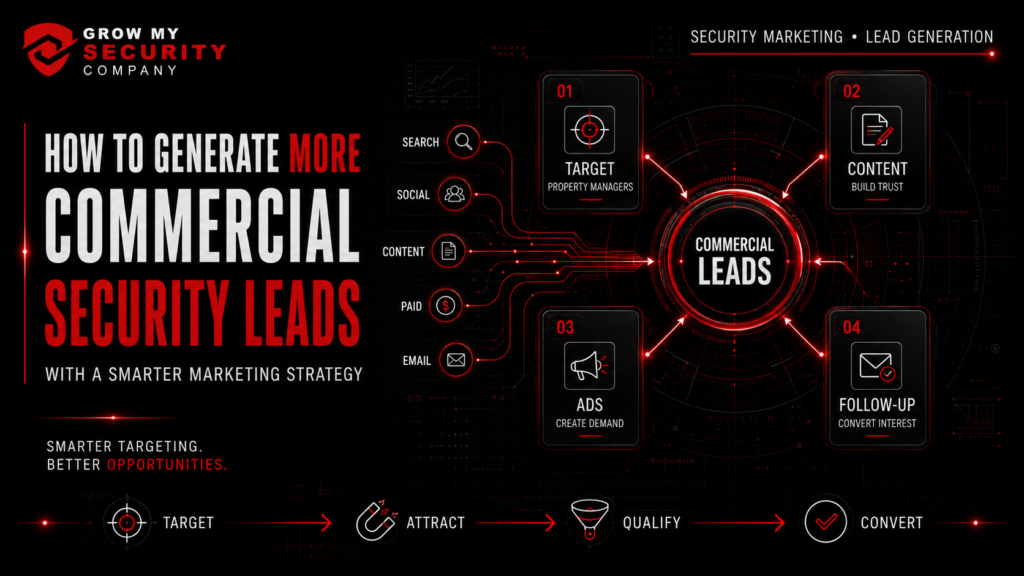
Local SEO and Google Business Profile capture buyers searching now. Service and site-type pages capture specific demand. Paid search fills the gap while SEO matures. Content builds authority and answers objections in advance. The website converts the traffic. Fast follow-up wins the deal. Tracking tells you where to put the next dollar.
Remove any one of those and the others underperform. Traffic without conversion is waste. Conversion without follow-up is waste. Follow-up without tracking means you will never know which half of the budget to cut.
Building that system in-house takes time most operators do not have spare. Our lead generation service for security companies assembles these pieces as one program rather than a set of disconnected tactics.
That is what a documented marketing strategy for a security company is for: connecting the channels to one number that matters, which is signed recurring contracts.
Common Mistakes That Cost Security Companies Leads
- Marketing to homeowners and commercial buyers with the same message and the same pages
- Running paid search with no negative keyword list, funding clicks from job seekers
- One generic services page instead of pages per service and site type
- No licensing, insurance, or supervision detail anywhere on the site
- Stock photography instead of real officers and vehicles
- Ignoring reviews and Google Business Profile entirely
- Responding to inbound leads in hours or days rather than minutes
- Following up once and moving on
- Measuring cost per lead while ignoring cost per contract
- Cutting marketing spend in a slow quarter, guaranteeing a slower one three months later
Frequently Asked Questions
How long does it take to generate commercial security leads?
Paid search can produce inquiries within days of launch. SEO and content typically take three to six months to show meaningful movement and continue compounding well beyond that. Most companies run both, using paid to cover the period while organic visibility builds.
What is the best channel for commercial security leads?
There is no single best channel. Local SEO and Google Business Profile tend to produce the highest-intent local inquiries, paid search produces the fastest, and content produces the best-qualified buyers over time. The right mix depends on your market, your competition, and how quickly you need pipeline.
How much should a security company spend on marketing?
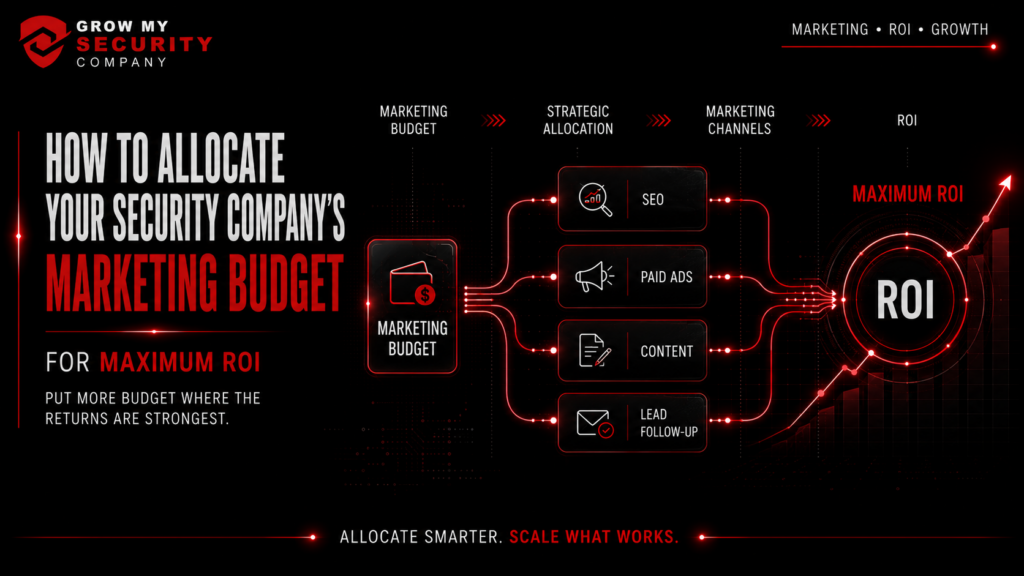
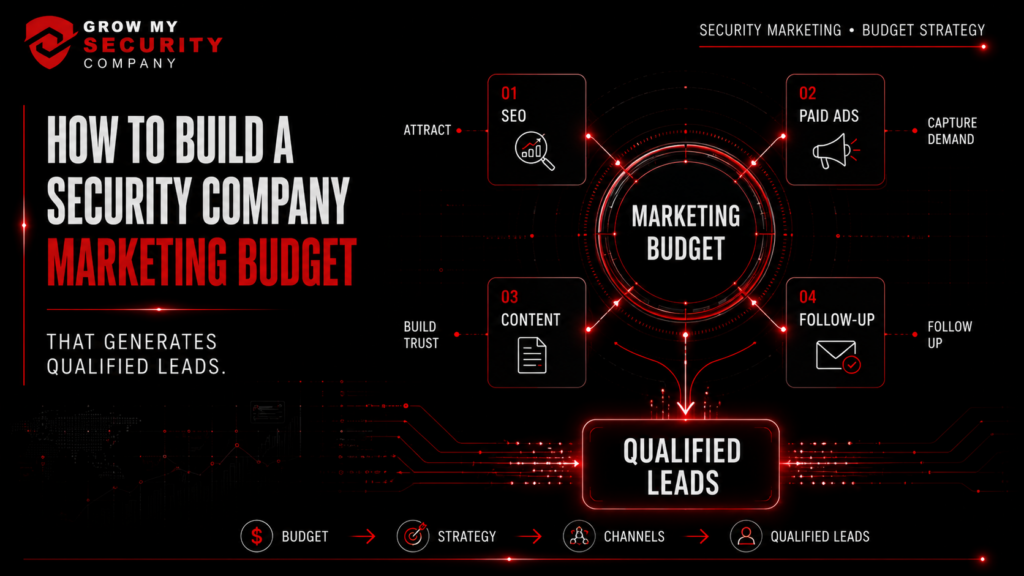
It depends on your revenue, growth targets, and average contract value. Because commercial contracts are recurring, the acquisition cost you can justify is much higher than most owners assume. Start from the lifetime value of an average account and work backward rather than picking a percentage at random.
Why are we getting leads that never convert?
Usually a targeting mismatch. Ads or pages written for a general audience attract residential inquiries and job seekers rather than facility managers. Tightening keywords, adding negatives, and building site-type pages typically improves lead quality faster than increasing spend.
Do security companies need content marketing?
It is not mandatory, but it is one of the few advantages a smaller company can build that a larger competitor cannot buy overnight. Content answering real buyer questions builds the authority that makes a buyer choose you over a cheaper unknown.
Should we market to residential and commercial clients together?
Keep them separate. They search differently, buy differently, and are worth very different amounts. Combining them on the same pages and in the same campaigns usually means the higher-value commercial buyer sees messaging that was not written for them.
Conclusion
Generating more commercial security leads is less about doing more marketing and more about aiming it correctly. Define who you are actually selling to. Build pages that match how those buyers search. Capture immediate demand with paid search while local SEO and content compound. Put your licensing, insurance, supervision, and reporting proof where buyers can find it. Then make sure your site converts and your team follows up fast enough to win.
Do that consistently and the pattern changes: fewer inquiries from people who were never going to sign, more conversations with property managers, superintendents, and facility directors who have a real requirement and a budget attached to it.
Grow My Security Company builds lead generation programs for security companies measured in qualified opportunities and signed contracts, not form fills. If you want a clearer picture of where your commercial leads should be coming from, schedule a free consultation and we will map it against your market.