What Security Teams Should Take From This
Most security company marketing budgets are set the same way: someone picks a number that feels tolerable, spends it until the quarter gets tight, then cuts it. Three months later the pipeline thins out, nobody connects the two events, and the cycle repeats.
The problem is that the number came first. A marketing budget is not a figure you can choose in isolation — it is the output of three things you already know: what an account is worth to you, how many new accounts you need, and how much it currently costs to win one. Work those out and the budget stops being a guess you defend and becomes a calculation you can show anyone.
This guide covers how to build that number from the ground up, what belongs inside it, how to phase spending when cash is tight, and how to tell whether it is working.
Start With What a Contract Is Actually Worth
Every budget decision downstream depends on this one number, and most security company owners underestimate it badly.
Take an average commercial account. Say it bills $12,000 a month and typically stays for two and a half years. That is $360,000 in contract revenue. Apply your gross margin — say 25% — and the account is worth roughly $90,000 in gross profit over its life.
Against a number like that, spending $3,000 to acquire the account is not a cost to be minimized. It is a 30-to-1 return that most owners would take every day of the week. Yet the same owner will often refuse a $2,500 monthly marketing budget on the grounds that it feels expensive.
Run this calculation for each of your main account types, because they differ enormously. A long-term retail contract, a two-month construction site, and a one-night event have wildly different values, and a budget that treats them identically will misallocate.
The output you want is a defensible maximum acquisition cost per account type. Everything else follows from it.
Work Out How Many Accounts You Need
Growth targets translate into lead volume through a chain of ratios, and each link needs a number.
Start with the revenue target. If you need $600,000 in new annual contract value and your average new account is worth $120,000 annually, you need five new accounts. Then work backward through your funnel: if one in three proposals closes, you need fifteen proposals. If one in four qualified leads becomes a proposal, you need sixty qualified leads. If half your inbound inquiries are qualified, you need a hundred and twenty inquiries.
Now the budget question is concrete. What does it cost to produce a hundred and twenty inquiries in your market? That is a question with a real answer, and it is a far better basis for a budget than a percentage of revenue.
If you do not know your conversion ratios, that is the first thing to fix. You cannot plan a budget on a funnel you have never measured, and the measurement costs nothing but the discipline to record outcomes in your CRM.
Account for Churn Before Setting Growth Targets
A number that trips up plenty of security companies: growth is net, not gross.
If you lose two accounts a year to contract non-renewal, price competition, or a client closing a location, then winning five new accounts is a net gain of three. If your target was five net, you need seven gross — a 40% increase in the lead volume you were planning for.
Look at your renewal history before setting the target. Companies with high churn often discover their marketing budget is largely funding replacement rather than growth, which is a signal to spend on retention and service quality rather than more top-of-funnel volume.
What Belongs Inside the Budget
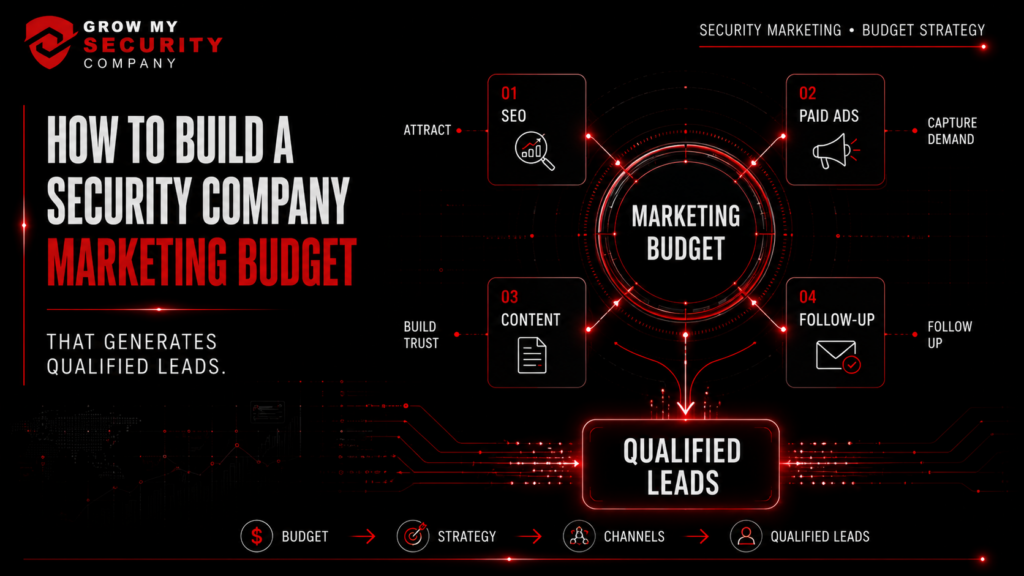
A marketing budget that only counts ad spend will consistently come in over. The full picture includes several categories that owners routinely leave out.
Foundation costs are the things that have to exist before any channel works: the website itself, hosting and maintenance, tracking and analytics setup, CRM, and call tracking. Some are one-time, some are ongoing, and skipping them undermines everything else.
Channel costs are the visible ones: paid media spend, SEO work, content production, Google Business Profile management, social, and any agency or contractor fees. Note that ad spend and ad management are separate lines — conflating them is a common way budgets get misread.
Sales enablement covers proposal templates, case studies, one-pagers, and anything your team sends during a deal. It is marketing spend even though it lives with sales.
Contingency should be five to ten percent. Opportunities appear — a trade show slot, a competitor’s key account coming up for renewal, a sudden need for emergency coverage advertising — and a budget with no slack cannot respond.
Split the Budget Into Foundation, Growth, and Test
Structuring the budget in three tiers makes it far easier to protect the parts that matter when money gets tight.
Foundation is what keeps the lights on: website, hosting, tracking, Google Business Profile, basic local SEO. This is not optional and should be the last thing cut. A company that cuts here is choosing to become invisible.
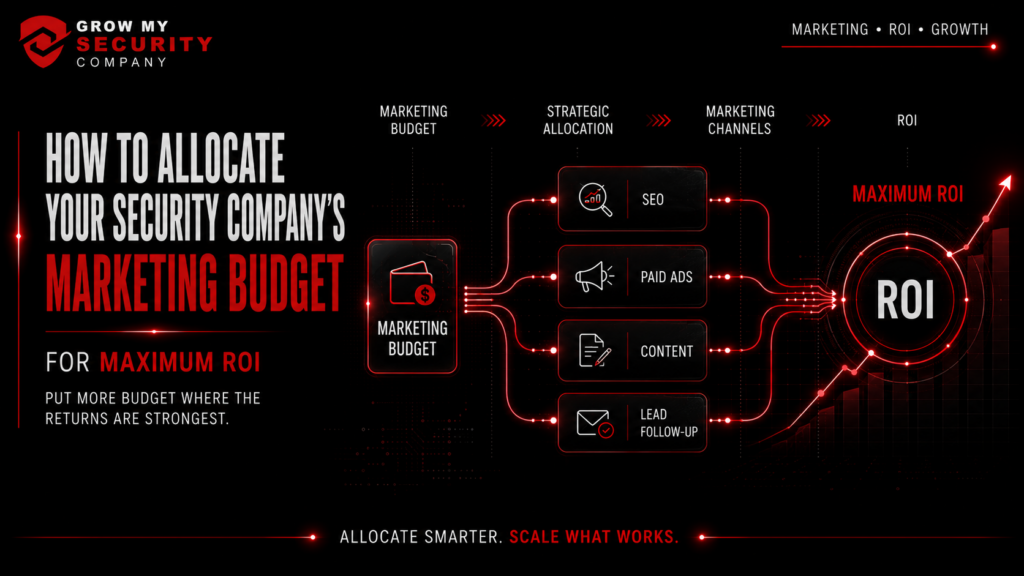
Growth is the majority of the budget and funds the channels actively producing pipeline: paid search, ongoing SEO, content, and lead generation. This is where increases and decreases should happen as results dictate.
Test is a small slice — often ten percent or so — for channels you have not proven yet. LinkedIn campaigns aimed at facility directors, a new site-type page cluster, retargeting, a trade publication. Most tests fail. The ones that work become next year’s growth line, and a budget with no test allocation never discovers them.
Match Spend to Your Growth Stage
The right budget shape changes depending on where the company is.
A newer company with no organic visibility should weight heavily toward paid search and foundation. Organic will not arrive in time to matter, so buying immediate demand while the site and local presence get built is usually correct. Expect a higher cost per lead during this period and accept it as the price of entry.
An established company with steady referrals but flat growth usually has the opposite problem: an aging website, a neglected Google Business Profile, and no content. The highest-return spending here is often conversion and local visibility work rather than more traffic. These companies are frequently losing deals they were already in the running for.
A company expanding into a new city needs to treat it as a new market entry, not an extension. Local pages, a separate Google Business Profile with a real address, region-specific paid campaigns, and enough patience to let local signals establish.
A company with strong pipeline but weak close rates should stop increasing lead spend entirely and invest in sales coaching and proposal quality. Pouring more leads into a leaking funnel is the most expensive mistake in this list.
Fund the Website Before the Traffic
The most common budgeting error in this industry is allocating everything to traffic and nothing to what happens after the click.
If your site converts at one percent and a competitor’s converts at three, they get three times the leads from identical spend. Fixing conversion is almost always cheaper than tripling the ad budget, and the improvement applies to every channel at once — organic, paid, referral, and direct all convert better.
Budget for the fundamentals: fast load times, clear service and site-type pages, visible licensing and insurance proof, mobile-friendly contact paths, and forms that ask for the minimum. A security company website built around conversion is a multiplier on every other line in the budget, which is why it should be funded early rather than deferred.
If you are unsure whether the site is the bottleneck, a website audit will tell you before you spend another month on traffic.
Budget for Both Immediate and Compounding Returns
Marketing channels pay back on very different timelines, and a healthy budget deliberately funds both.
Paid search produces leads immediately and stops producing them the moment you stop paying. It is rented demand — reliable, controllable, and permanently expensive.
SEO and content produce nothing for months and then produce leads that keep arriving without incremental cost. This is owned demand, and it is what eventually lowers your blended cost per lead.
Fund only paid and you stay on a treadmill where growth requires proportional spend forever. Fund only organic and you have no pipeline for two quarters. Most security companies do best running both, with paid covering the gap while organic matures, then rebalancing as organic visibility takes hold.
That rebalance is the point. A company three years into consistent SEO should be spending proportionally less on paid for the same lead volume. If that is not happening, the organic investment is not working.
Budget by Service Line, Not Just in Total
A single pooled budget hides which parts of the business are actually growing.
Break the budget down by the service lines you want to grow. Construction site security, retail loss prevention, event security, fire watch, and executive protection have different competition levels, different search volumes, different contract values, and different seasonality. Some deserve aggressive investment and others do not.
This also prevents a familiar failure: spending evenly across all services, ranking for none of them, and concluding that marketing does not work. Concentrating budget on two or three service lines where you have genuine proof and reasonable margins produces far better results than spreading it thin.
The same logic applies geographically. Three cities covered properly beats eight covered nominally.
Plan for Seasonality
Security demand moves through the year, and so should the budget.
Construction security tracks the building season in most markets. Event security peaks around the warm months and the holidays. Retail loss prevention spikes in the fourth quarter. Fire watch demand often follows weather events and building system failures rather than any calendar.
Spending a flat twelfth of the annual budget every month means underspending exactly when demand is highest and overspending when nobody is searching. Map your own inquiry history by month and shape the budget to match, keeping enough reserve to push harder in the months that historically convert best.
Decide What You Will Measure Before You Spend
Set the measurement framework before the first dollar goes out, because retrofitting attribution is painful and usually incomplete.
At minimum you need call tracking numbers by channel, form submissions tagged with source, a CRM recording lead source through to contract outcome, and a monthly review of cost per lead, cost per qualified lead, and cost per signed contract by channel.
That last one is the number that should drive budget decisions, and it frequently contradicts the first. A channel producing leads at $80 that never close is worse than one producing leads at $400 that sign quarterly contracts. Without outcome tracking, most companies cut the second and double down on the first.
Connecting your CRM to marketing is what makes cost per contract visible. Until it is, budget decisions are being made on lead volume — which is the metric most likely to mislead.
Review Quarterly, Not Annually
An annual budget set in January and left alone until December wastes money for eleven months.
Review quarterly against what actually happened. Which channels produced contracts, not just leads? Where did cost per contract rise or fall? Which service lines gained traction? What did the test allocation reveal? Then reallocate — moving money toward what worked is the single highest-return activity in marketing management, and it costs nothing.
Keep the total steady while shifting the mix, unless results justify a genuine increase. Constant changes to the total make it impossible to read whether anything is working.
What to Do When the Budget Is Small
Not every security company can fund a full program at once, and the answer is sequencing rather than spreading thin.
Fix the website and tracking first, because everything else depends on them. Then claim and optimize Google Business Profile, which is free effort with immediate local return. Then build the three or four service pages that match your most valuable account types. Then add a modest paid search budget on your highest-intent terms only, tightly negative-keyworded.
That sequence produces results at each stage rather than requiring the full budget before anything works. Adding content and broader SEO once leads are flowing is a much easier decision to fund, because by then the program is paying for itself.
Common Budgeting Mistakes
- Setting the number first and working backward to justify it
- Counting ad spend only, then treating overruns as a surprise
- Funding traffic while ignoring a website that converts poorly
- Spreading budget evenly across every service and every city
- Cutting marketing in a slow quarter, guaranteeing a slower one later
- Measuring cost per lead instead of cost per signed contract
- No test allocation, so no new channel is ever discovered
- Ignoring churn when setting growth targets
- Flat monthly spend in a seasonal business
- Increasing lead spend when the real problem is close rate
Frequently Asked Questions
How much should a security company spend on marketing?
There is no universal figure. The defensible method is to calculate the lifetime gross profit of an average account, decide how many new accounts you need, apply your funnel conversion rates to get the required lead volume, and price what producing that volume costs in your market. That produces a number you can justify rather than one you picked.
Is SEO or PPC better for a security company budget?
They solve different problems. PPC produces leads immediately but stops when spending stops. SEO takes months and then produces leads without incremental cost. Most companies fund both, weighting toward paid early and rebalancing toward organic as visibility builds.
What should we cut first if the budget shrinks?
Cut the test allocation first, then reduce growth channels proportionally. Protect foundation spending — website, hosting, tracking, and Google Business Profile — because cutting there removes your ability to convert the traffic you still get.
How long before a marketing budget shows returns?
Paid search can show inquiries within days. Conversion improvements show up immediately across all channels. SEO and content typically take three to six months for meaningful movement. Judge each channel on its own timeline rather than expecting uniform results at ninety days.
Should marketing budget be a percentage of revenue?
Percentage-of-revenue rules are a sanity check, not a planning method. They ignore your contract values, close rates, competition, and growth stage. Build from the funnel math, then compare the result to a percentage to see whether it is realistic.
Do we need an agency or can we do this in-house?
It depends on whether you have someone whose actual job is marketing, rather than an owner doing it between operational fires. The work is ongoing — weekly search term reviews, content production, tracking maintenance — and it tends to be the first thing dropped when operations get busy.
Conclusion
A security company marketing budget built from contract value, growth targets, and funnel math is defensible in a way that a percentage or a gut figure never is. It tells you what you can afford to spend to win an account, how many accounts you need, and therefore what the program has to cost.
Structure it in tiers so you know what to protect. Fund the website before the traffic. Run immediate and compounding channels together. Concentrate on the service lines and cities where you can genuinely win. Then measure to signed contracts and reallocate every quarter.
Done that way, the budget stops being an expense you argue about and becomes a number tied directly to how many new accounts the company will sign this year.
Grow My Security Company builds documented marketing strategies and full-service programs for contract security firms and other security businesses. To build a budget around your actual contract values and growth targets, schedule a free consultation.